The Aquatic Cyborg
What old shorelines can and cannot tell us about human social evolution
December 20, 2025 · substantially revised September 1, 2026
The standard textbook story of human social evolution goes something like this: for most of our 300,000-year history, Homo sapiens lived in small, mobile, egalitarian bands. We roamed the savanna, hunting game and gathering plants. Complexity, including sedentism, division of labor, durable inequality, and political hierarchy, arrived after agriculture.
It is a clean narrative. It is too clean for the evidence.
A 2022 paper by Singh and Glowacki in Evolution and Human Behavior assembles comparative ethnographic and archaeological evidence against that "nomadic-egalitarian model." Their alternative is the diverse histories model: non-agricultural societies have occupied a wide range of social arrangements, and some of that variation probably extends deep into the Pleistocene. Dense, predictable resources can make larger aggregations, storage, and reduced mobility more feasible. Aquatic resources are one important case, not a switch that turns hierarchy on.
That empirical correction is interesting on its own. It also opens a more speculative question: did maritime technology alter the developmental and evolutionary problems that humans repeatedly had to solve?
What the Coastal Record Says
At Pinnacle Point Cave 13B in South Africa, deposits dated to roughly 164,000 years ago contain evidence of marine shellfish use. The assemblage also includes a fragment of a whale barnacle. A later taxonomic study identified it as a barnacle associated with right whales and proposed scavenging from a stranded whale.
Those observations establish early use of coastal resources and place a whale-associated object in the cave assemblage. Scavenging a stranded whale is a plausible interpretation. The fragment does not, by itself, establish ropes, organized harvesting at scale, permanent settlement, social rank, or even exactly how the barnacle reached the deposit. Those propositions need independent evidence.
Later Pleistocene sites add shell middens and other records of repeated coastal use. A midden can show recurrent or intensive harvesting. It cannot by itself distinguish a seasonal aggregation from repeated short visits, semi-sedentism, or year-round residence. Nor does repeated residence tell us who held power.
Ethnographic comparisons provide the next step in the argument. In several well-studied settings, concentrated and seasonally predictable resources such as salmon runs or shell beds coexist with storage, lower mobility, large gatherings, inherited wealth, or political differentiation. The comparison matters because it shows that agriculture is not a necessary condition for those arrangements. It does not show that aquatic resources are sufficient, or that every coastal group followed the same path. Population density, mobility options, exchange networks, conflict, institutions, and local history can all change the outcome.
The defensible archaeological claim is therefore modest: Late Pleistocene social life was probably more varied than a single model of small, mobile, egalitarian bands allows. The coastal record contributes to that correction. It does not yet give us a 164,000-year-old village hierarchy.
Now for the speculative extension.
The Cyborg Hypothesis
Intertidal shellfish can be gathered without boats. Offshore fishing, routine crossings, and transport between islands place different demands on tools and coordination, but the tools themselves preserve badly. Archaeologists therefore use indirect constraints, especially the occupation of islands that were never joined to a continent.
Humans reached Sahul after crossing stretches of open water, although the timing, routes, vessels, and organization of those crossings remain debated. On Sulawesi, stone artefacts at Calio date to at least 1.04 million years ago. The maker is unknown. The site shows that an archaic hominin population reached Sulawesi, an island separated by ocean barriers. It does not identify that population as Homo erectus, show us a boat, or tell us whether the initial crossing was deliberate, repeated, or accidental. Calling the makers accomplished seafarers would outrun the find.
The hard constraint is still remarkable: some hominins crossed water barriers long before the oldest surviving watercraft. That fact makes maritime adaptation a legitimate subject for evolutionary hypotheses, even when it cannot settle any particular hypothesis.
Here is the candidate feedback loop:
- Reliable aquatic opportunities make some new forms of harvesting, movement, and aggregation worthwhile.
- Groups develop tools, skills, and coordination practices that improve access to those opportunities.
- Those practices expose learners to recurring demands in navigation, timing, cooperation, maintenance, and teaching.
- Cultural evolution, development, and perhaps natural selection alter how later groups meet those demands.
The arrows are conjectures to be tested, not facts read directly from shell deposits.
The Aquatic Cyborg Hypothesis: In some human lineages, maritime technologies became persistent parts of the developmental and ecological system. Existing capacities made rudimentary water travel possible; water travel then changed which resources, routes, partners, and problems those groups encountered. Over enough generations, tools and users could have co-shaped one another without either a single cognitive mutation or a boat causing intelligence.
I like the phrase exosomatic organelle for the boat. It is a metaphor, not a claim that a hull is biologically an organelle. For a crossing, the relevant functional unit can be a person plus a vessel, learned practices, other crew, and local environmental knowledge. Remove any one of those and the reachable journey may disappear.
The Steering Problem
This is where coherence dynamics enters the picture.
In my previous post, I argued that a compact control interface can steer a much larger physical state, and that an abstract algorithm may omit causally relevant features of its realization. The "soup" provides the physical terrain; the "sparks" provide part of the steering. That is a control hypothesis, not a dimensional test for consciousness.
The Aquatic Cyborg hypothesis extends that logic to an organism using technology.
A terrestrial primate has an action set constrained by anatomy, terrain, learned practice, and social support.
Now give that primate a boat.
Routes, resources, and encounters that were previously unreachable may become reachable. The boat also creates new failure modes: capsizing, drift, maintenance errors, mistimed tides, and coordination failures. In control language, the technology changes the system's affordances, its observation-action interface, and its reachable set under specified conditions.
Earlier versions of this argument said that a boat literally "transforms the topology" of a behavioral manifold. That is stronger than the evidence permits. A topological claim needs a defined state space, constraints, and intervention map. The testable version asks which actions become reachable, at what cost and reliability, after a particular technology is introduced.
Marine navigation may also shift the balance of cognitive work. Currents, winds, waves, tides, landmarks, and seasonal changes can reward prediction over time. Terrestrial wayfinding is not a static scalar-map problem; it also involves weather, moving animals, changing vegetation, social threats, and uncertain routes. The useful hypothesis is comparative: under matched difficulty and experience, do maritime tasks demand different combinations of temporal prediction, distributed attention, memory, teaching, or crew coordination? That can be measured. A slogan about "more cognitive dimensions" cannot substitute for the measurement.
The compact insight survives the correction. A relatively small physical interface can reorganize a much larger set of possible actions. The boat is a control interface to water, but its effects depend on the craft, crew, ecology, and task.
Rethinking the "Human Revolution"
Older accounts often placed a sudden "behavioral revolution" around 50,000 years ago, marked by art, ornamentation, long-distance exchange, and other material traces. The record now looks more geographically uneven and temporally staggered than that label suggests.
An extended-system account offers one possible part of the explanation. Changes in transport, harvesting, storage, and connectivity could make existing capacities easier to express, preserve, or spread. It also makes a testable prediction: where maritime technology matters causally, changes in access and coordination should precede or accompany the behavioral changes attributed to it.
Several rival explanations remain live. Demographic growth can sustain cumulative culture. Climate can redistribute resources and routes. Social networks can preserve and recombine innovations. Neural or developmental changes may matter. Archaeological visibility can change without any cognitive change at all. Maritime technology could be an effect of those changes rather than a cause.
Coastal preservation makes the comparison harder. At the Last Glacial Maximum, global mean sea level was roughly 120 metres below today's level. Much of the late-glacial coastal landscape now lies on submerged continental shelves.
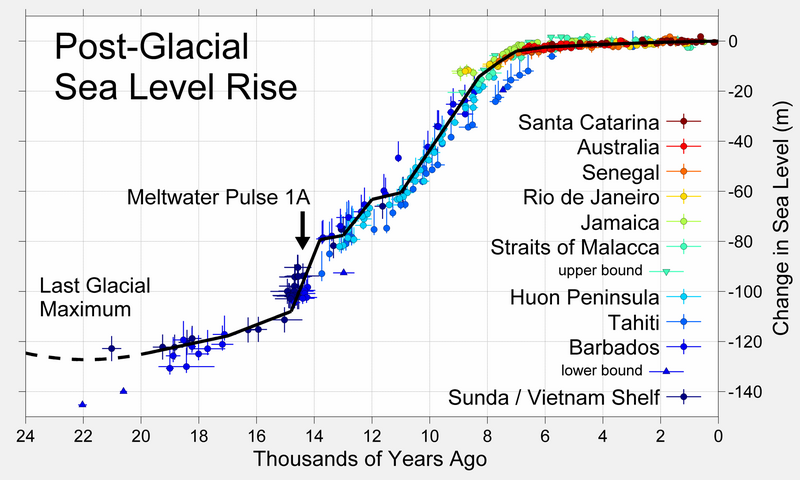
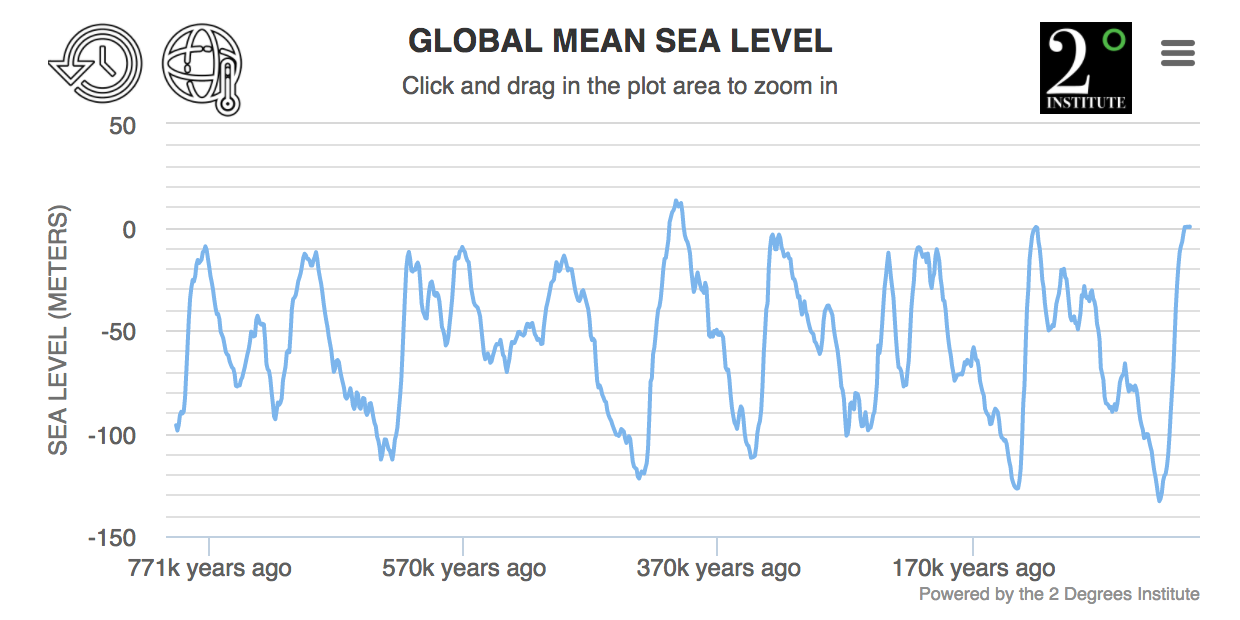
That creates a real sampling bias. It predicts where evidence may be missing and where underwater archaeology could look. It does not convert missing coastal sites into positive evidence for boats, settlements, or social complexity.
The inland record is an important rival to any coast-first story. Large-game hunting, plant processing, river systems, raw-material exchange, and other terrestrial activities could also demand planning and cooperation. Megafaunal extinctions were heterogeneous and had interacting climatic and human causes; they do not support a simple story in which complex coastal groups moved inland after dangerous animals disappeared. Ecology belongs in the model as one contributor alongside demography, technology, institutions, networks, climate, and historical contingency.
No Politics Falls Out of a Shell Midden
The diverse histories model weakens appeals to one ancestral social default. It does not tell us that ecology mechanically produces equality or hierarchy.
Resource concentration, predictability, defensibility, and storability can alter the bargaining problems a group faces. They can make aggregation or accumulation easier. Norms, kinship, mobility, coalition building, violence, leadership, and deliberate institutional choices mediate what happens next. A salmon run cannot write a constitution.
So the political conclusion is deliberately limited. Human groups have probably occupied more than one durable social arrangement for a very long time. Neither egalitarianism nor hierarchy follows automatically from that history, and neither becomes morally justified by being old.
"Cyborg" names the dependence of human possibilities on bodies, tools, other people, and environments. It is useful when it generates a sharper causal question. It becomes empty when it merely redescribes every human as technological.
What Would Test It?
The hypothesis gains content only if it can lose.
It would be strengthened by:
- Temporal ordering: independent evidence that maritime access or tool systems appeared before the specific changes in mobility, coordination, or learning attributed to them.
- Matched comparisons: coastal and inland cases compared while controlling, as far as the record allows, for resource density, predictability, population size, climate, and network position.
- Mechanistic evidence: experiments or ethnographic studies showing that particular maritime tasks recruit different predictive, teaching, or coordination strategies from matched terrestrial tasks.
- Convergent traces: combinations of artefacts, residues, faunal remains, seasonality measures, mobility data, and settlement structure that support the same maritime-use reconstruction.
It would be weakened by:
- maritime technology consistently appearing only after the social or cognitive changes it is meant to explain;
- inland populations showing the same changes under matched ecological and demographic conditions;
- marine and terrestrial navigation producing no relevant difference once task difficulty and experience are controlled; or
- submerged-landscape research repeatedly failing to find the predicted associations where preservation and survey coverage are adequate.
Pinnacle Point gives us early coastal resource use. Calio gives us an unknown hominin population on Sulawesi. Neither site gives us the whole feedback loop. The next step is to test the links between access, task demands, social organization, and transmission rather than hide those links inside the word "cyborg."
This post draws on Singh and Glowacki's "Human social organization during the Late Pleistocene" in Evolution and Human Behavior (2022), the Pinnacle Point marine-resource record, the PP13B whale-barnacle study, and the Calio artefacts from Sulawesi. The published control context is developed in High-Dimensional Coherence.